

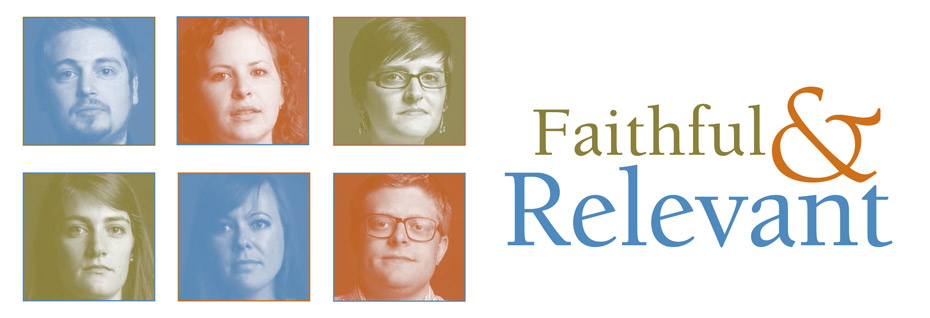
 With careers in accounting, education, military service, and pastoral ministry, six recent Augsburg alumni are finding that their undergraduate experiences studying vocation and interfaith leadership are paying off well beyond their college years.
These Auggies participated in the Christensen Scholars and Interfaith Scholars programs at Augsburg—programs that provide scholarships for students to take upper-level religion courses that thrust them deep into topics of faith, religious diversity, service, theology, and vocation.
Meeting on weeknight evenings throughout the academic year, students engaged with these topics—and each other—through focused discussion, inquiry, service-learning, and reflection. The number of scholarships available each year is limited, so getting into the program is a competitive process, involving writing an essay and obtaining a recommendation from an Augsburg College faculty or staff member. Students accepted to the programs earn four religion credits and a $2,000 scholarship for the year. But, according to some of the early alumni from the programs, the value of the experience extends well beyond course credit and financial support.
Grappling with vocation
One of the aspects that Auggies in the Christensen Scholars and Interfaith Scholars programs valued most about the experience was the dedicated time to learn and to grapple together with difficult topics and questions.
“Having that regular, dedicated time for discussion helped us to better articulate our gifts, strengths, and passions,” said Emily Wiles ’10, a youth and family ministry major who this spring earned a Master of Divinity from Luther Seminary. “We pushed each other to articulate our positions, which helped me really connect with what I think and who I am,” she said. As a result, “things that I might have otherwise taken for granted, I came to ‘own’ as my gifts.” In having to express and explain your perspectives, Wiles said, “you really get to know yourself better.”
Also beneficial, according to several alumni, was the opportunity to reflect on the full meaning of vocation. “My generation is going to have 15 different jobs or careers in our lifetimes,” said Cody Tresselt-Warren ’09, who majored in accounting and religion at Augsburg and today is a tax accountant at Wells Fargo & Company.
“You think, when you’re in college, that once you graduate and get a job, you’re set,” he said. But there are so many other important layers—from family obligations to the needs of the wider world—that, “you have to interpret your calling from a number of perspectives. It’s a dynamic, evolving journey.”
Sylvia Bull ’10 agreed, noting that, especially in the U.S.—a generally career-oriented culture—it is important to expand the view of vocation beyond just a job or career. Bull, an international relations and religion double major who this spring completed her third year at Princeton Theological Seminary in Princeton, N.J., sees faith as serving an important role in considerations about vocation. We need to “open our eyes of faith to see all of the things that we do in our lives as part of God’s call,” she said.
And “even if faith is not explicitly part of the conversation,” said Jessica Spanswick ’10, who today works as director of career services at Globe University, “it is a profound, shared human desire to seek and find meaning in our lives.”
Welcoming difficult conversations
Alumni from these programs also shared an appreciation for how their experiences helped them develop the listening and interpersonal skills to learn from and understand others. “We learned to step boldly and respectfully into difficult conversations,” said Peter Weston Miller ’10, “meeting people where they were at, where God had uniquely called them to be.”
Weston Miller, an English major who also completed his Master’s of Divinity at Luther Seminary this past spring, said these conversations taught the participants how to “build relationships based on human integrity and dignity, not just [based on] topics” that they agreed upon.
“We learned to know ourselves better through the eyes of others, despite different backgrounds, political leanings, and socio-economic statuses,” he said.
In particular, alumni from the programs valued the opportunity to interact and work with people who bring different faith perspectives. “Speaking with people from many different faith backgrounds helped me learn to listen to and understand others’ views and beliefs,” said Spanswick, who majored in international relations at Augsburg and recently completed her MBA at Globe University. In her current work, Spanswick meets people from many different cultures, and she noted that their cultural practices often differ because of faith traditions.
Whitney Pratt ’11, who majored in economics at Augsburg and serves as a first lieutenant in the U.S. Air Force, agreed that interfaith competency is an important life skill. “Religion is such an important facet of our lives,” she said. “Most of our political struggles center around topics that stem from the moral foundations” that different groups of people use to guide their behaviors and interactions in society.
“You can try to build intercultural competence, but without understanding religion,” Pratt said, “you won’t be fully effective.” To function as a citizen in today’s world, “you have to understand how people think and the beliefs on which they base their social and moral codes.”
Asking tough questions
In the end, these Auggies agreed that the programs’ greatest value was that they equipped participants to ask challenging life questions—seemingly simple (but, actually, not-so-simple) questions like, “Where have you come from—and where are you going?” and “How do you know you’re on the right path?”
Consistently, all of these alumni said it was the questions—not the answers—that were most meaningful to them. In fact, they have each continued the practice of asking and reflecting on difficult questions and they shared some of the questions they regularly encounter in their lives today:
- “Am I questioning my current path because I don’t like it [today] or because it’s really not my calling?”
- “How do I remain true to my Lutheran beliefs and still operate in an ecumenically diverse organization?”
- “How will what I want to say affect this other person?”
- “If this current path is not my calling, what’s the best step to take to explore what is right?”
- And, the question that Martin Luther is famous for: “What does this mean?”
“As our lives and our world change,” Weston Miller said, “we need to keep asking these questions in order to keep ourselves expanding, growing, nurturing, and propelled forward in God’s calling for all of us.”
Continually asking these questions and searching for meaning helps us to see the world not just as it is, Wiles added, but as it could be.
You Might Also Like

What is it?
- on July 22, 2014
From game time to lifetime
- on July 22, 2014