

Today, higher education has come under question—is the debt worth it, are students graduating at sufficient rates, are we educating enough of our population, are students actually learning what they need?
In this environment, the value of higher education increasingly is being defined—by parents and prospective students alike—as “getting a good job.” In fact, this is the No. 1 reason cited by U.S. respondents in the 2012 Gallup/Lumina poll for pursuing education beyond high school. And the second reason? To earn more money.
“When college students and their parents think about the value of higher education, they typically think about it too narrowly,” said Brandon Busteed, executive director of Gallup Education. “People tend to get caught up with things—like potential income or getting a job with a ‘blue chip’ company—that don’t matter” when it comes to predicting career success and satisfaction, Busteed said. “Focusing on those things is not the best way to think about a great job and a great life.”
 “WELLBEING” AS A MEASURE OF CAREER SUCCESS
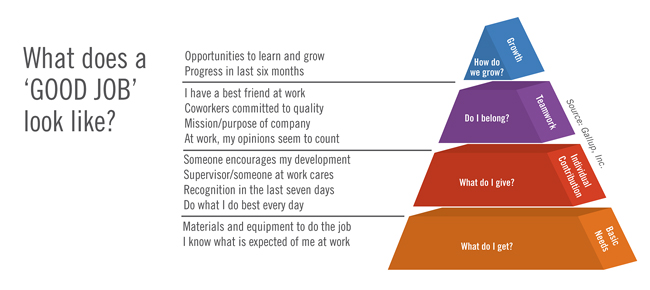
What factors do predict career success? According to Gallup, it’s being able to respond affirmatively to statements like the following:
- “I like what I do each day.”
- “I do what I do best every day.”
- “My supervisor cares about my development.”
- “I have a best friend at work.”
Agreeing with statements like these indicates that a person is engaged in interesting and meaningful activities at work, is using his or her strengths to achieve goals, is motivated by the team leader, and is supported by colleagues who share a common purpose. Those characteristics, according to Gallup’s “wellbeing” research, correlate more with top performance than income or title or working for a prestigious organization.
Gallup has been studying wellbeing, on a global basis, since the 1930s.
“Wellbeing is not ‘wellness,’” Busteed said. “It is a multidimensional measure of how people rate their lives.”
In the past several decades, Gallup’s study of people in more than 150 countries has revealed five universal, interconnected elements that shape our lives: career wellbeing, social wellbeing, financial wellbeing, physical wellbeing, and community wellbeing.
“We didn’t invent these categories,” Busteed said. “The factors that correlate with wellbeing are what we found from the data collected over time and across populations.” Of those five interconnected elements of wellbeing, career wellbeing is the most important, Busteed said.
“Our careers are a fundamental piece of how we define ourselves,” Busteed said. “Plus, work is where you spend the majority of your waking hours,” so it is going to have a major impact on your life evaluation—not to mention your social, financial, and physical wellbeing.
Gallup’s research shows that those who have high career wellbeing are 4.5 times more likely to be “thriving”—versus merely surviving or, worse, suffering—in life. However, just 31 percent of the U.S. population has very high career wellbeing.
WELLBEING AND WORKPLACE ENGAGEMENT
The career wellbeing issue is connected with low worker engagement, Busteed said. According to Gallup’s 2012 “State of the American Workplace” report, only 30 percent of full-time U.S. workers are engaged and inspired at work. Fifty percent are not engaged, the report states—“they’re just kind of present, but not inspired by their work or their managers.” The remaining 20 percent of all full-time U.S. workers are actively disengaged in their jobs.
One significant driver of high or low engagement is a person’s manager, Busteed said. People looking for a “good job” focus so much on income and landing a position at a “good” company, but finding a good manager is vastly more important than working for a well-known company, he explained.
Another factor causing low worker engagement is whether a person is using her or his strengths every day. “Not just once in a while, not once every week or so, but every day,” Busteed said. Among college graduates, he said, the lack of opportunity to use one’s strengths at work every day points to career misalignment—either getting a degree in a field in which one isn’t able to get a job or pursuing a field because of others’ expectations instead of based on one’s own strengths.
“The onus is certainly on the individual [student], but it is also on the college and mentors to make sure that students are asking themselves” what they are truly good at, what engages and excites them, Busteed said.
EDUCATIONAL EXPERIENCES THAT SUPPORT CAREER SUCCESS
In addition to studying workplace dynamics that correspond with career wellbeing, Gallup also has identified specific college experiences that correlate with subsequent career success. In its research, Gallup has found two educational experiences that are twice as likely as other factors to predict high work performance:
- Working on a long-term project that took several classes to complete, and
- Using what was learned in class to develop solutions to real-world problems.
In short, Busteed said, “what works in school is ‘real work.’”
“Real work”—including problem-solving and experiential education opportunities—helps prepare students for success after graduation, but Gallup also has done extensive research on the factors that predict success during college. Here, Busteed said, Gallup has found that “hope” is statistically a stronger predictor of educational outcomes than test scores or grade-point averages. (In fact, according to the work of Gallup Senior Scientist Shane Lopez, hope is the leading indicator of success in relationships, academics, career, and business—as well as of a healthier, happier life.)
HOPE: AN IMPORTANT FACTOR IN COLLEGE SUCCESS
“Hope is a strategy,” Busteed said. However, it is not just wishful thinking, he explained. Instead, it refers to one’s ideas and energy for the future and includes the following three elements:
- Attainable goals,
- The ability to see multiple pathways to achieve those goals, and
- Agency—i.e., a belief that you can achieve your goals.
Measures of hope, engagement, and wellbeing account for one-third of the variance of student success in college, Busteed reported. And, although college success is also driven by other things—such as academic preparation and content knowledge—those things are being measured fairly consistently and systematically through cognitive measures, such as tests.
“But no one is paying attention to measuring the non-cognitive factors that account for a whopping one-third of student success,” Busteed said. “We need better balance and alignment around how we track and promote student success [in college].”
The same is true for college outcomes, where job placement percentages and average salaries tell only part of the story. “What’s the ultimate outcome of an education?” Busteed asked. “To have a better life,” he said. We need to pay attention to how we measure that.
Â鶹ԭ´´ AND CAREER WELLBEING
MATCHING YOUR GIFTS TO THE NEEDS OF THE WORLD
According to Gallup, career wellbeing requires that people understand what they are truly good at and pursue career opportunities that allow them to use their strengths every day.
Augsburg calls this vocational discernment.
“Augsburg is about forming and shaping students to lead lives of meaning and purpose,” said Mark Tranvik, professor of religion and director of Augsburg’s Bernhard Christensen Center for Vocation. “At Augsburg, we encourage students to move beyond self-enhancement and think about their lives within a wider horizon. We want them to ask questions like, ‘What am I good at?’ and ‘How can my gifts best be used to make a difference in the world?’
“For many at the College,” Tranvik said, “faith plays an important role in how those questions are answered.” The exploration of one’s gifts is rooted deeply in the Lutheran theological tradition of vocation, and it is a critical part of the educational journey at Augsburg—for students of all faith and spiritual backgrounds, Tranvik said.
FINDING THE RIGHT WORKPLACE ENVIRONMENT
Another important part of the self-discovery journey is determining what types of work environments might suit you best, said Keith Munson, director of the Clair and Gladys Strommen Center for Meaningful Work. “You can get a job doing something you love, but if that job is not in the right place—the right work environment or culture—you won’t be able to sustain your motivation for the job very long,” he said.
In other words, you need to pay attention to where and how your gifts will be used.
A good way to learn about work environments is through informational interviews, Munson said. “Networking, of course, ensures that people learn more about you than can be picked up from your résumé, but that’s not the only reason to network,” he said. It is as important “for you to actually find out if a given company or department is a good place for you to work.”
Determining whether a given work environment is a fit, however, requires that you understand what kind of work cultures and relationships are best for you. This involves self-reflection and, usually, some amount of coaching. But many students—and many adults in job transitions, for that matter—skip that step and just focus on securing a job.
EXPANDING THE DEFINITION OF A “GOOD JOB”
Munson said he understands why students (and their parents) think it’s important to get a “good job” after college. “For many students, following their passion without worrying or thinking about their income is not a realistic option,” he said. “I always tell these students that it’s okay for them to think about the realities of their career choices. You can be practical about those matters and still pay attention to the other piece”—the search for work and work environments that suit you—as well.
“You’re looking for a job anyway,” Munson tells students. “Why not also try to find something that you are going to like to do?” In fact, Munson said, by actively seeking work environments that suit them, students tend to be more effective in the job search process. “When you are looking for something—and someplace—that’s interesting to you, you are likely to be more motivated in the job search,” he said. You’ll do more background preparation, seek more informational interviews, and ask more purposeful questions.
In the end, Munson said, students shouldn’t think that they need to choose between following their hearts and getting a “good job.” You can—and should—do both.
You Might Also Like

Homecoming 2013
- on November 25, 2013
In memoriam: Marie Olive McNeff
- on November 25, 2013