

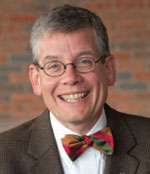
By Paul C. Pribbenow
 As I write this column, there are reports from far and near of conflicts in the world that reflect fundamental questions about our values and aspirations. We have witnessed clashes on the Augsburg campus between different lifestyles and value systems. We have experienced shootings in our neighborhood and lived in the aftermath of violence in our community. We have seen mass gatherings in neighboring states reflecting deep divisions in visions of a good society and a good life. And we have felt the rising tide of freedom and democracy in nations around the world and the seismic shifts underway in political and social systems.
The challenge we must face as a teaching and learning community is what we will do in the face of this conflict. Will we withdraw and wait to see what happens? Or will we find in the various conflicts the “stuff” of a liberal arts education and the inspiration to put our education to work in engaging the conflicts and seeking to make a difference in the world?
I think it is fair to assume that the Augsburg community chooses the latter challenge.
Recently, prospective Augsburg scholarship students were asked to reflect on a provocative quote from the great American educator and philosopher, John Dewey, who once wrote:
Conflict is the gadfly of thought. It stirs us to observation and memory. It instigates to invention. It shocks us out of sheep-like passivity, and sets us at noting and contriving. Not that it always effects this result; but conflict is a ‘sine qua non’ of reflection and ingenuity.
As I listened to these aspiring Auggies consider what Dewey intended, I was convinced that this
quote gets at the heart of an Augsburg education.
Our students learn to observe and remember. Our students engage and learn from the messiness
and complexity and conflict of the world through experiences on campus, in our urban neighborhood, and around the world. Our students—indeed our entire community—are shocked out of passivity to be informed, thoughtful, and courageous actors in the world.
This issue of Augsburg Now offers ample evidence of Dewey’s argument for the links between conflict and learning. Chris Stedman’s journey through interfaith dialogues—a growing aspect of an Augsburg education—illustrates how our students face otherness and difference in considering their own callings in the world. The work of our MBA students helping neighborhood youth start a small business reflects the ways in which Augsburg’s location in the city shapes an education that does not flinch from the realities of urban life. And the good reports on student research projects offer important evidence of how an Augsburg education— across the disciplines—challenges our students to fight complacency, to push the edges of learning, and not to settle for what is expected.
I am proud to report that in our classrooms and residence halls, on campus and out in the community, and indeed all around the world, Auggies are pursuing what John Dewey called us to be— informed citizens, thoughtful stewards, critical thinkers, and responsible leaders. We are learning from our experiences of the complexities and messiness and conflicts of the world—and then we are getting to work in our own ways, with our distinctive gifts and callings.