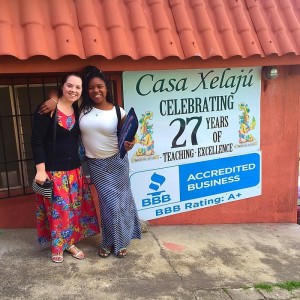
Katie is a junior at Duke University, currently studying abroad in Central America with CGEE. This is an excerpt from . Her blog is a great resource for anyone considering study abroad in Central America!
What does flexibility look like traveling in Central America?
It looks like getting used to rescheduling your classes when they’re cancelled due to protests over corruption (Guatemala) or the building of a new canal (Nicaragua).
It looks like knowing your taxi or shuttle might not arrive on time, without letting that stress you out.
It looks like figuring out how to bathe in a little den with a pot of boiling water and two buckets.
It looks like not being scared to ask for directions every once (or twice) in a while.
It looks like being open to making mistakes while learning a new language and understanding that you won’t understand everything. And that’s okay.
…And it looks like realizing that sometimes the best experiences in life are the unplanned experiences.
This post was written by CGEE staff member Lucy Hardaker, who works at the Minneapolis office at Augsburg College.
The CGEE Central America semester students are some of the busiest study abroad students around. Not only are they going through an experiential program, but they are doing so amid a busy travel schedule! It was always difficult for me to fully grasp what a “Day in the Life” of a student must be like, but after my short visit to Nicaragua, I am beginning to understand.
First up was a full day of Nicaraguan sightseeing in the cities of Granada and Masaya, including the Masaya Volcano. This was a great introduction for both me and the students, as they had just arrived from Costa Rica only a few days earlier.
The next day, I learned what the academics of CGEE are all about. Students began the day with discussion, and then were taken to a local non-profit center (Coordinadora Civil), where we listened to a guest panel about getting the local youth involved with their country’s politics and social movements.
After lunch, I was given a tour of the Batahola Norte neighborhood where CGEE semester students stay while in Managua. Ruth Garrido guided me around multiple host families’ homes. Although I do not speak Spanish (Ruth translated for me), it was clear to see from happiness on each one of their faces that they thoroughly enjoyed hosting students.
The next day, I saw experiential education in action. Class began with a short film on the history of Augusto Sandino, followed by a discussion about the film, and a previously assigned reading. After the discussion, students were brought to Loma de Tiscapa – the site on which Sandino was executed, where there now stands a monument to him that watches over the entire city.
After only a few short days with CGEE Central America Students, I was finally able to see why our programs are so transformative with my own two eyes. Not only were the Central America staff some of the most friendly, welcoming, and dedicated individuals I have ever met, but the knowledge of the region’s history and culture combined with experiential education model is one of the best ways for students to truly understand the culture in which they are studying.
Post from Hannah Schmit, Augsburg College student who traveled to El Salvador as part of a winter break course. Hannah also recorded a about her experience.
The crowded plane jostled onto the tarmac and my travel-wearied body snapped Alert. The piercing lights of distant planes cut through the dark blue haze of night. We had arrived in San Salvador. For the following ten days, I along with my classmates and professor, journeyed through the streets, cities, and lives of the people of El Salvador. We began in the city and were given invaluable experiences with church groups and speakers who explained the history of the tumultuous country and gave us glimpses of the true heart of the people. We traveled to a town called Suchitoto, where we heard pure voices of those who had experienced tragedy as they tried to teach us how to forgive. Another voice from Suchitoto spoke of peace and music, of dancing and love, and most importantly of using the gifts given to us by God to make the most out of our lives. From Suchitoto we traveled to Nueva Esperanza, new hope, and met with calloused hands and friendly smiles. The people of Nueva Esperanza showed us the power of family and community in the face of adversity. We remember those who have shared their lives with us and we honor those who passed in the civil war.